Gdansk Poland
A Jewel On The Baltic
COVID slowed us down for a couple of years, and now a few health issues challenge us. We're still traveling if not writing about it quite so much. Our goal in 2022 was get to all seven continents in one year... and we did it.
Going forward health issues may not allow us to travel. No one can take away those memories though. We hope all of you are well and staying safe... and that you find some inspiration here for YOUR future travels.
Gdansk could be your port of entry in Poland if you take a Baltic States or Northern Europe Cruise.
It could also be your first stop if you enter Poland by ferry as we did.
We arrived in Poland after a long overnight ferry ride from Nynashamn, Sweden.
It was kind of a fun introduction because we were about the only non-Polish passengers on the ferry.
Driving into the center of the town was surprisingly easy...
We just followed the signs to the center of the city... "centrum"...
Even hotels were marked in relatively
easy to read signs.
That's saying something because Polish is NOT easy to read!
Get A Hotel Near The Center Of Gdansk
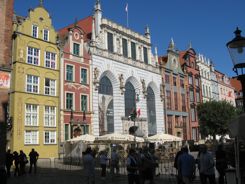
There is lots to explore, starting with just looking at the wonderful architecture of the Old Town.
It's hard to believe that 90 percent of this city was destroyed or damaged in World War II.
The buildings and churches have been painstakingly restored or rebuilt.
Walk along the pedestrian walkway along the river front.
This walkway, the Dlugie Pobrerze, hugs the Motlawa River bank.
See the crane, the Zuraw, the largest medieval port crane in Europe (though this too has been reconstructed).
The buildings along the riverfront are impressive and colorful. (Even the buildings that have been turned into a hotel look like individual houses.)
Enjoy The River From Both Sides
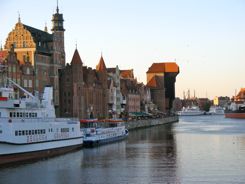
You can view the riverfront best by walking over the bridge that is a
continuation of the Long Street.
Or take the small pedestrian ferry across in front of the crane.
It's free if you have a ticket from the
Maritime Museum that is housed in the Crane Building.
Into Town Away From The River
Back on the town side of the river... Leave the river and pass through the Green Gate to stroll the Long Street... the Dlugi Targ and Dluga, its narrower continuation.
It's also a pedestrian street lined with great buildings.
Highlights are the Artus Court and the Neptune Fountain in front of it.
The Uphagen House further down on Dluga has been recently restored, but it's 17th century Rococo paneling was not damaged in the war, and it's fun to see.
Walk all the way to the end of the Ulica Dluga and go through the Golden Gate (we had to do this since we're from the San Francisco area!) and the Highland Gate.
If you're so inclined, you can check out the Prison Tower and torture museum while you're there... or just pass through like we did!
Browse the amber shops.... they're everywhere, but especially along the very pretty Ulica Mariacka.
This street, Ulica Mariacka (ulica means street) runs parallel to Ulica Dluga. You reach it from a side street, or you can enter it through the Mariacka Gate on the riverfront.
Like much of Gdansk, most of the buildings were rebuilt after WWII, but it contains outstanding examples of traditional Gdansk architecture.
There are lots of churches to see. Most are historic, but they're comparatively plain inside because they were rebuilt. We didn't go to the shipyards, but signs of the Solidarity Movement were everywhere.
Arriving In Gdansk
You may drive in like we did, or you could take the train to arrive at the central railway station, Dwonec Glowny. It's a beautiful old building in its own right... a great introduction to the city's architecture.
You may also find yourself arriving by air.
The Lech Walesa Airport has become a destination for many low cost air connections from all over Europe. Maybe because Poland is still a bargain to travel in.
There are also domestic flights from Warsaw or Krakow.
There are transfer buses to the central train station, which is right on the edge of the Old Town, about every half hour.
No matter how you arrive in Gdansk, this pretty Baltic city is definitely worth a visit.
Happy travels... even if you don't travel the world... just remember that life is a journey... embrace and enjoy it! Judy and Mark
Curious about what else we've written about? Search our site for a destination or travel tip.
But... We'd love to have you share this page or comment on it…
Thanks, Judy and Mark

Return to International Travel Tips l Europe Travel Tips
Go to MouseToursTravels Home Page

Timely Tips
Summer Vacation
Travel is fun in the Northern summer... but don't neglect the Southern Hemisphere at this time of year.
Yes, it's winter in South Africa, but that's their dry season. It's a good time to travel there.

Sometimes you need to watch rain patterns instead of just seasons to figure the best time to travel...
Whether you're taking a road trip close to home or traveling abroad...
Whether it's summer or winter in your part of the world...
the way you pack can make it all more pleasurable.
Check out all our Packing Lists and Tips.
Need travel ideas?
Things to See in Europe
Africa Calls!
Travel In America
Don't just dream about it...
Start making plans!
Custom Tour Planning List
International Travel Planning Tips
Foreign Is Fun - Not Scary!
Get Your Passports and Visas
And Expect Good Things
There Are Tourist Angels
Search
Search MouseToursTravels
Travel questions or destination info?
Find our answers faster...
Translate
We want you to feel comfortable out in the world and on our pages - so surf away in your own language...
Updated Tips & New Travel Stories


-
2022 Travels To All Seven Continents
 After COVID, all seven continents in one year was a worthy goal for our 2022 travels..
 -
2021 Travels - Another COVID Year?
 Our 2021 travels were only domestic. COVID kept us close home. Road trips and a cautious flights but still fun.
 -
2020 Travels - What Travels?
 Our 2020 travels were slim. COVID kept us home too. One trip to the Three Guyanas, but dreaming of travel next year.
Two Ways To Like Us!
Like Our Site Top Left
Like Our Fanpage Below
Thank You!
More On Poland
If the ordler looks odd, it's listed this way because this was the route we drove... Enjoy
Gdansk
Driving In Poland
Malbork and Elblag
Elblag Canal
Warsaw
Krakow Sights
Exploring Krakow
Krakow Legends
Krakow Salt Mines
Krakow Neighborhoods
Polish Air Museum
Tipping In Poland
And For Fun…
Confusing Polish Detour Sign
Ready For A New Adventure?
We escape by traveling…
But there are more ways to escape.
Work on something you LOVE…
With A Website
SBI Teaches You Everything

New! Comments
Have your say about what you just read! Did it help with your travel planning and preparation? Eager to leave on that next vacation? Please leave your tips or comments in the box below.